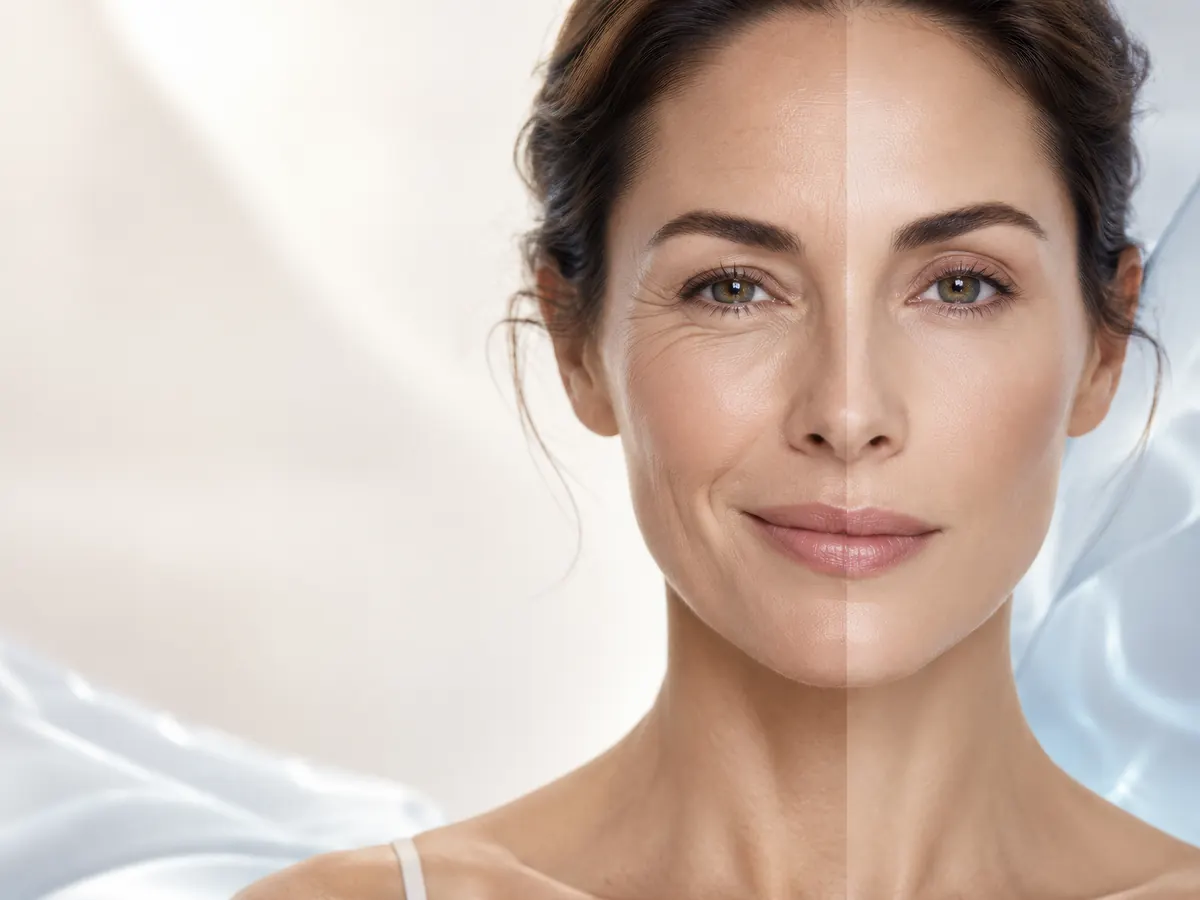
Expression lines and static wrinkles are not the same thing.
That distinction matters because different visible lines respond to different kinds of care.
A serum for expression lines should not promise to erase every wrinkle. It should explain which kind of line it is built to support and where the limits are.
The Shift
Skincare buyers are becoming more precise. They are no longer asking only for anti-aging. They are asking whether a product is for fine lines, expression lines, static wrinkles, firmness, texture, or barrier support.
That precision is useful because the skin does not show time in one uniform way. Lines caused by repeated movement are different from deeper creases that remain when the face is still.
What Most People Get Wrong
Most people treat every line as the same problem.
That leads to mismatched routines. A product designed to support the look of movement lines may not meaningfully change a deeper static fold. A resurfacing active may improve texture while doing little for expression-linked movement patterns.
The more honest question is: what kind of line are you trying to address?
The Ingredient / Product Truth
Expression lines appear with facial movement, such as smiling, squinting, frowning, or raising the brows. Static wrinkles remain visible when the face is relaxed. Fine lines are often shallower and can be influenced by hydration, barrier comfort, and texture.
| Line type | How it appears | Routine implication |
|---|---|---|
| Expression lines | Visible with repeated movement | Neuropeptides and hydration can support a softer look |
| Fine lines | Shallow surface lines | Hydration, barrier support, and consistent care matter |
| Static wrinkles | Visible even when the face is still | Often need broader routine support and realistic expectations |
A peptide serum can be useful when it is clear about the visible concern it is supporting. It should not claim to erase folds or reverse skin aging.
Why It Matters for Your Skin
This matters because skin confidence often improves when the routine matches the actual concern.
If your lines are mostly linked to movement, a neuropeptide serum may make sense. If your concern is deeper static creasing, the routine may need broader support: SPF, retinoid tolerance if appropriate, hydration, barrier care, and professional guidance when needed.
What to Look For
When choosing a serum for expression lines, look for:
- Clear expression-line language
- Neuropeptides such as Argireline, SNAP-8, or Leuphasyl
- Hydration and barrier support
- Realistic timelines over weeks, not overnight promises
- No claim that a topical serum erases static wrinkles
- Instructions for consistent daily use
Where Selfore Fits
Selfore Whisper is built for expressive skin: the skin around eyes, forehead, brows, and mouth that moves all day.
Its 11% neuropeptide system supports the appearance of softer expression lines, while GHK-Cu, Matrixyl 3000, ectoine, panthenol, hyaluronic acid, and beta-glucan support visible skin quality around that core purpose.
The Takeaway
Expression lines are not a flaw in the face. They are evidence that the face moves.
The right serum should support the look of skin without asking expression to disappear.
FAQ
What is the difference between expression lines and static wrinkles?
Expression lines are linked to facial movement and appear most clearly when the face moves. Static wrinkles remain visible when the face is relaxed.
Can a peptide serum help expression lines?
A peptide serum with neuropeptides may help soften the appearance of expression lines with consistent use, but it should not promise injectable-level results.
Can a serum erase static wrinkles?
No topical serum should claim to erase static wrinkles. Serums can support visible skin quality, hydration, texture, and firmness, but deeper wrinkles need realistic expectations.
Where does Whisper fit?
Whisper is designed for expressive skin and uses an 11% neuropeptide system for the appearance of softer expression lines, supported by copper peptide, Matrixyl 3000, and barrier-support ingredients.
How do I know which kind of line I have?
Look at the skin when your face is relaxed and when it moves. If the line appears mainly with movement, it is more expression-linked. If it remains at rest, it is more static.
References
Selfore · Journal · Skin Biology · N°04
Published - May 11, 2026 · Last reviewed - May 26, 2026
This article is for general education. It is not medical advice. Consult a board-certified dermatologist for guidance on any clinical concern.
Footnotes
Coban, I., Erkmen, F. Y., & Aktaş, G. D. (2025). Dynamic periocular wrinkle patterns: an anatomical study on young adults. Journal of Cosmetic Dermatology. https://doi.org/10.1111/jocd.70215. See also published clinical literature on regional wrinkle distribution: upper face wrinkles predominantly dynamic, lower face wrinkles predominantly static. ↩ ↩2
Lee, H., Hong, Y., & Kim, M. (2021). Structural and functional changes and possible molecular mechanisms in aged skin. International Journal of Molecular Sciences, 22(22), 12489. Discusses the structural progression of skin wrinkles from dynamic creasing to permanent static folds in aging dermis. ↩
Coban, I., et al. (2025), op. cit. - describing dynamic wrinkles as predisposing the periorbital region to static wrinkles "from a young age." ↩
Uitto, J. (2008). The role of elastin and collagen in cutaneous aging: intrinsic aging versus photoexposure. Journal of Drugs in Dermatology, 7(2 Suppl), s12 - s16. https://pubmed.ncbi.nlm.nih.gov/18404866/ ↩ ↩2
Shin, J. W., Kwon, S. H., Choi, J. Y., Na, J. I., Huh, C. H., Choi, H. R., & Park, K. C. (2019). Molecular mechanisms of dermal aging and antiaging approaches. International Journal of Molecular Sciences, 20(9), 2126. https://doi.org/10.3390/ijms20092126 ↩
Quan, T. (Ed.). (2023). Molecular Mechanisms of Skin Aging and Age-Related Diseases. See also: Frontiers in Physiology (2023), Skin aging from mechanisms to interventions: focusing on dermal aging, https://doi.org/10.3389/fphys.2023.1195272 ↩ ↩2
Glogau, R. G. (1996). Aesthetic and anatomic analysis of the aging skin. Seminars in Cutaneous Medicine and Surgery, 15(3), 134 - 138. The Glogau Photoaging Classification is referenced in dermatology, cosmetic surgery, and dermatologic research literature worldwide. ↩
Carruthers, J. A., Lowe, N. J., Menter, M. A., et al. (2002). A multicenter, double-blind, randomized, placebo-controlled study of the efficacy and safety of botulinum toxin type A in the treatment of glabellar lines. Journal of the American Academy of Dermatology, 46(6), 840 - 849. ↩