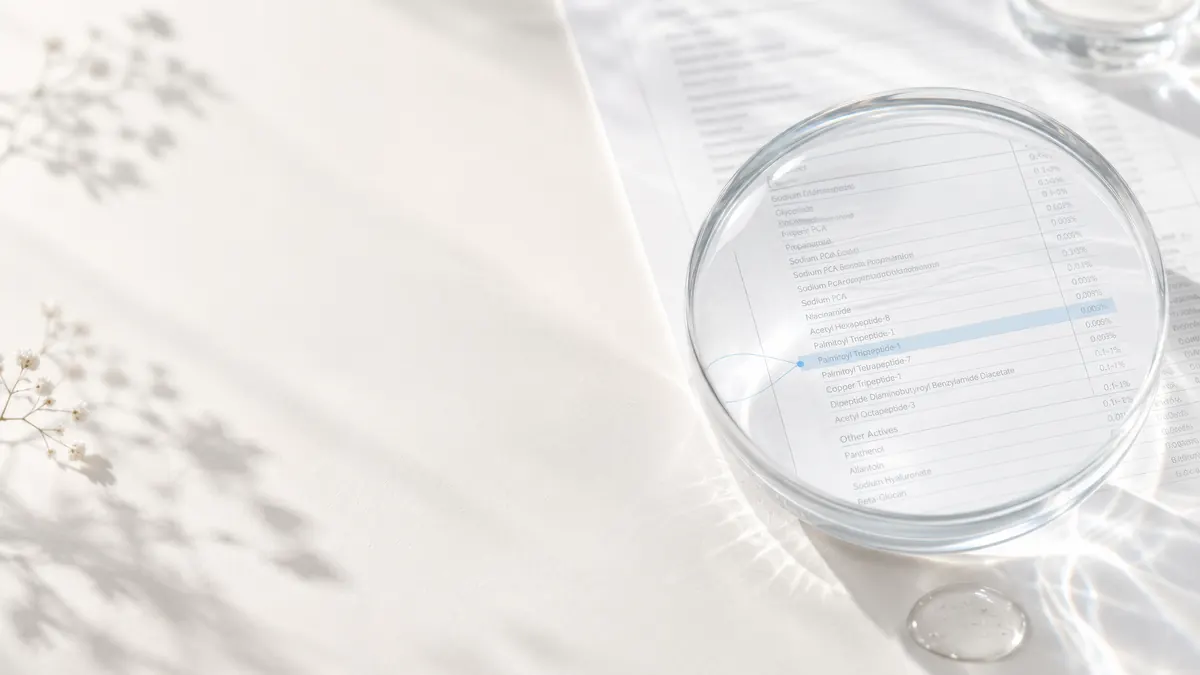
A peptide serum label can look scientific while hiding the most important information.
The ingredient name matters, but it is not enough.
A stronger label helps you understand the peptide strategy, the concentration context, the support ingredients, and the claims you should trust.
The Shift
Skincare buyers are reading labels more carefully. They want the back of the carton to match the front of the campaign.
That shift matters in peptide skincare because many formulas name expensive-sounding peptides without explaining whether the formula uses them meaningfully.
What Most People Get Wrong
Most people scan for peptide names and stop there.
That misses the harder questions: where does the peptide sit on the INCI list, is the percentage disclosed, which mechanism category does it represent, and what support system surrounds it?
A peptide name without context is not a formulation strategy.
The Ingredient / Product Truth
INCI lists are useful but limited. Ingredients above 1% are generally listed in descending order. Below the 1% line, order becomes less informative, and many peptides sit in that zone.
That is why concentration disclosure matters. If a brand publishes active loads, the buyer does not have to guess whether the formula is serious.
It also helps to read for categories: neuropeptide, signal peptide, carrier peptide, support ingredients, preservation system, and irritant load.
Why It Matters for Your Skin
A clearer label helps prevent mismatched expectations.
If you want expression-line support, look for neuropeptide logic. If you want visible resilience and copper peptide support, look for GHK-Cu context. If your skin is reactive, read for fragrance, essential oils, drying alcohol, and barrier support.
What to Look For
When reading a peptide serum label, look for:
- Named peptide forms, not vague peptide language
- Concentration disclosure or a clear formula rationale
- Different peptide categories rather than repeated mechanisms
- Barrier and hydration support
- Fragrance-free status if skin is reactive
- Claims that match cosmetic evidence
- Packaging and storage guidance for formula stability
Where Selfore Fits
Selfore publishes the key active loads for Whisper: Argireline 8%, SNAP-8 1.5%, Leuphasyl 1.5%, 1% GHK-Cu, 1% ectoine, 2% panthenol, 0.5% dual-weight hyaluronic acid, and 0.5% beta-glucan.
The point is not to make the label louder. It is to make the formula easier to evaluate.
The Takeaway
A peptide serum label should reduce uncertainty.
If the label asks you to trust the peptide story without showing the peptide strategy, keep reading before buying.
FAQ
Are skincare ingredients listed in order of concentration?
Ingredients above 1% are generally listed in descending order. Ingredients below 1% may appear in any order, which makes peptide concentration hard to infer from INCI position alone.
What is the 1% line?
The 1% line is the point in an ingredient list below which ingredients do not have to be listed in exact descending concentration order.
Why does peptide concentration disclosure matter?
Disclosure helps buyers understand whether a peptide is present at a meaningful load or simply named for marketing value.
What should I look for in a peptide serum label?
Look for named peptides, mechanism categories, concentration context, support ingredients, routine guidance, and realistic cosmetic claims.
What does Selfore disclose about Whisper?
Selfore discloses the 11% neuropeptide system, 1% GHK-Cu, 1% ectoine, 2% panthenol, 0.5% hyaluronic acid, and 0.5% beta-glucan.
References
Selfore · Journal · Formulation Principle · N°08
Published - May 11, 2026 · Last reviewed - May 26, 2026
This article is for general education. It is not medical advice. Consult a board-certified dermatologist for guidance on any clinical concern.
Footnotes
Personal Care Products Council. International Cosmetic Ingredient Dictionary and Handbook (the INCI Dictionary). The INCI system was established in the 1970s and is recognized by regulators in most major cosmetic markets including the EU, US, Canada, Japan, and Australia. ↩
European Commission, EU Cosmetic Regulation 1223/2009. United States Food and Drug Administration (FDA), 21 CFR 701.3. Canada, Cosmetic Regulations under the Food and Drugs Act. All three regulatory frameworks require ingredients to be listed in descending order of concentration above 1%, with ingredients below 1% permitted to be listed in any order. ↩ ↩2
Cosmetic chemistry industry guidance on common ingredients used at or near the 1% concentration threshold. See published cosmetic formulation references on preservative use levels, including European Commission regulatory limits. ↩
European Commission, Annex V of EU Cosmetic Regulation 1223/2009. Maximum authorized concentration of phenoxyethanol in cosmetic products is 1.0%. ↩ ↩2
Published clinical research on cosmetic peptide concentrations: Blanes-Mira, C., et al. (2002). International Journal of Cosmetic Science, 24(5), 303 - 310 (Argireline 10%); Wang, Y., et al. (2013). American Journal of Clinical Dermatology, 14(2), 147 - 153; Pickart, L., & Margolina, A. (2018). International Journal of Molecular Sciences, 19(7), 1987 (GHK-Cu concentrations). ↩
Robinson, L. R., Fitzgerald, N. C., Doughty, D. G., Dawes, N. C., Berge, C. A., & Bissett, D. L. (2005). Topical palmitoyl pentapeptide provides improvement in photoaged human facial skin. International Journal of Cosmetic Science, 27(3), 155 - 160. Matrixyl efficacy demonstrated at concentrations as low as 3 ppm. ↩
Ledwoń, P., Errante, F., Papini, A. M., Rovero, P., & Latajka, R. (2023). Insights into bioactive peptides in cosmetics. Cosmetics, 10(4), 111. https://doi.org/10.3390/cosmetics10040111 ↩